The WinRM client received an HTTP server error status (500)
After a coworker installed SharePoint on an Exchange 2010 server, we received the following error when trying to access the EMC:
“Connecting to remote server failied with the following error message: The WinRM client received an HTTP server error status (500), but the remove service did not include any other informaition about the cause of the failure. For more information, see the about_Remote_Troubleshooting Help topic.
- CategoryInfo : OpenError: (System.Manageme….RemoteRunspace:RemoteRunspace) [], PSRemotingTransportException
- FullyQualifiedErrorId: PSSessionOpenFailed”
ESM gave this error:
“Connecting to remote server failied with the following error message: The WinRM client received an HTTP server error status (500), but the remove service did not include any other informaition about the cause of the failure. For more information, see the about_Remote_Troubleshooting Help topic. It was running the command ‘Discover-ExchangeServer -UseWIA $true -SuppressError $true’.”
We were unable to rebuild the directories using PowerShell. The Exchange Management Troubleshooter didn’t fix it. The common resolutions are all over the web but all refer back to Kerberos/Windows Authentication, an environmental variable, .NET modules, and so on but none worked for me. I troubleshot for hours with no luck.
If they don’t work, check the web.config file in c:\inetpub\wwwroot. A default file is way less than 1k — I think that mine was something like 500 bytes — but this one was 12k. The issue was that SharePoint modified it very heavily because during install, the default IIS options were not modified and it tried to install to the Default Website on port 80. Renamed this to oldweb.config, copied in the fresh one from my server, IISRESET, and we were good as new.
Hope this helps someone out.
Symantec System Recovery 2011 Management Solution = Worst. Shit. Ever.
On the 26th of May, I published something called “Unfun With Symantec System Recovery 2011.” This proved to be this blog’s biggest source of traffic. The other day, I discovered that it made it to the second page of Google when searching for “Symantec System Recovery 2011” and as it turns out, it’s going back and forth between the second and first page. Hilarious! It’s the first non-Symantec website listed about their product. If that doesn’t make a statement, I don’t know what does.
Since making that post, I had to install SSR’s management console because it was sold to a client. I started in the morning and one failed install and about three hours later, it was in! A few hours later, I had the client pushed to all of my VMs, software configured, ready to go. As it turns out, the management platform is kind of cool if you cut out all of the bullshit and spend some time with it. A tip: from the home page, follow the links on the left that specifically deal with SSR. Don’t even bother with the other menus. Could be worse.
Know what could not be worse, though? The fucking installation process. Yet again, I am trying to install it. The machine is a brand new, 100% fresh install of Windows Server 2008 R2, absolutely nothing installed on it. It has been about four hours. The first installation failed because the services didn’t start correctly and of course, instead of rolling back, it just left it there, broken. I tried to run the “Reconfigure” command and it bombed out twice. Between those failed attempts, I installed Symantec Endpoint Protection 12’s management console. It took fifteen minutes, start to finish, no problems whatsoever.
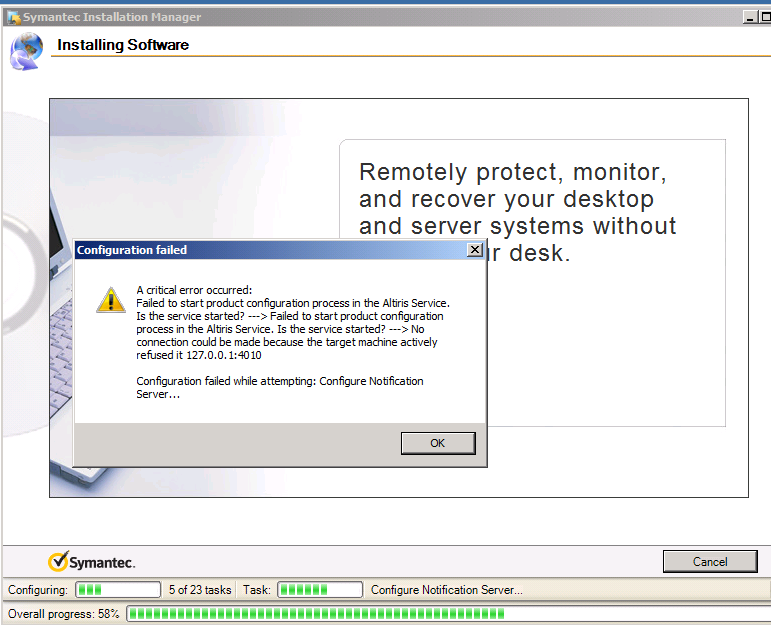
I heard they're trying to get enough Dalmatians to make a coat, too. This was added after I wrote this post -- failure number three.
My point of this post, then, is to reiterate my absolute disgust with Symantec and the developers of this product for allowing it to see the light of day in its current state. The message it sends to administrators trying to deal with it is very clear: “We don’t give a shit.” Know how I know that? Because if they gave a shit, if they gave half a shit, if they cared enough to pay someone else to give a shit for them, this would not happen. To echo the thoughts of someone who commented on my original post, we sell this product because of its price point but spend so much time troubleshooting that any profit made is lost almost immediately.
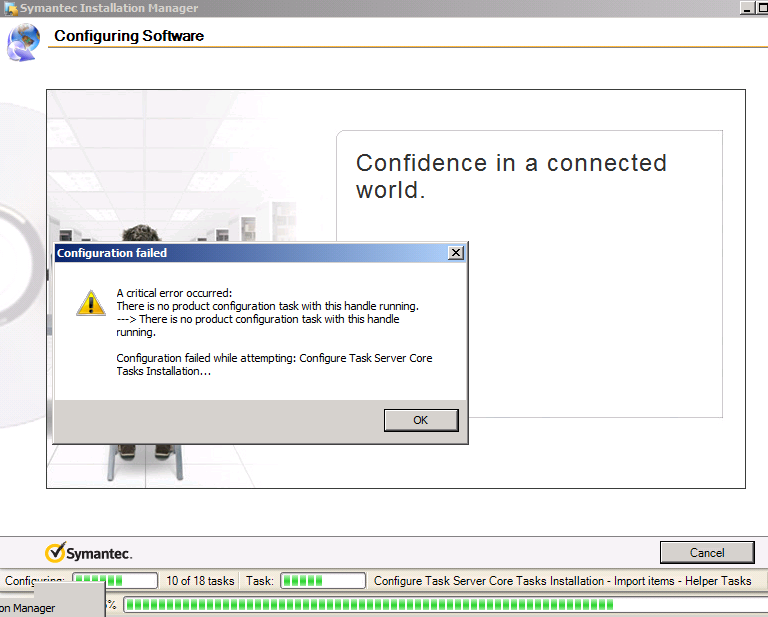
This was failure number four, added after the post was published.
Nothing more to say. I would love to see my post about the shittiness of this product make it closer to the top of Google, so do everyone a favor and click here, find my post, and give it a click.
Good Recordings Take Time. Time Takes Money. Deal With It.
EDIT: HOLY SHIT, THIS IS LONG! I like being thorough. Sorry.
I mulled through a number of condescending subjects before finally settling on this, which is much nicer than the working title, “Don’t Be a Fucking Idiot.” In the end, I decided that just because something is logical to me and many others, that doesn’t make it universal knowledge, and it isn’t really fair of me to penalize others for just not having the experience to know this stuff. But, whatever. Let’s get to work.
Fact: good recordings take time. The better your sound, the more time it will probably take. Sure, there are exceptions, especially since your definition of “good” is going to be different than mine, but for a big, professional-sounding recording, you need to expect to spend some time.
Fact: good recordings are usually not cheap. There are exceptions, studios and guys who don’t give a shit and want to undercut the competition, or buddies who will cut you a deal. Generally speaking, though, you need to expect to pay a couple hundred dollars a day for anything good. This is because recording gear is expensive. You know how a good guitar costs $1000 or more and then you spent maybe $1400 on your amp and cab? Well imagine doing that over and over and over and over again, never being finished. Some examples: I bought a single microphone for $1400 last year. I only use it for guitars. My A/D conversion cost about $3000, when all was said and done. My computer cost about $1000. In software, I’ve spent even more than that. There are preamps, other mics, cables, acoustic paneling — it just does not end. Everything good is expensive and that means that if a studio wants to continue upgrading their stuff so they can do the best possible work, they need to charge. In other words, if you want to use this awesome shit to record, you need to realize that it is a major investment for the studio, which means you are going to pay more than you would if your buddy was doing it with his $600 stuff from Guitar Center.
Got that? Good. So let’s keep going.
A band wanted me to record their full-length. Before committing to it, they wanted to do a single song as a demo. This is a great idea because a full-length is quite a commitment and has some special pressure attached to it, so I like making sure that a band is comfortable with what I can do before they sign on. This particular band cited a massively overproduced deathcore band as an example of what they were looking to sound like. That shit is not cheap, that shit does not happen overnight. That shit is expensive. I made all of this abundantly clear.
Back to the demo, though, the band wanted to do one song. This band plays death metal. While they are a great band, experience teaches everyone involved with recording metal that most bands have a few members who just aren’t as prepared as they tell themselves. Once you get under the microscope, tiny inconsistencies become major issues and with each successive take, your time to complete the project increases, meaning your cost goes up. This is the nature of recording and with music that requires extreme technical ability, it means that good recordings take much longer than a band usually expects. As a result, I told them to budget for three or four days. I explained everything above in very simple language. I also explained that since they were being funded by a label, it is better to ask for more money than they need and then return what is left after the fact than ask for too little at the start and need more. This is a very basic concept in budgetting. You never plan for the best-case scenario — never. So we have that.
The band balked, “Dude. We are good. With our last recording, we did six songs in one day.” Yeah, and it sounds like shit. Clearly, you weren’t happy with it, or you’d be going back there. If you did six songs in one day, you probably recorded live and unless you are Hate Eternal, there are probably mistakes all over the place. If it was tracked and fully mixed in one day, you went to someone who either doesn’t know what they are doing or doesn’t give a shit. Comparing this recording to professional practices is simply not apples-to-apples. It’s apples-to-fucking… pizza. Apples-to-sushi.
So why should a band budget three or four days to do one song? Aside from the fact that I hadn’t worked with them before and they were playing music that always takes longer to record than expected, there’s the fact that they stated that they wanted extremely high quality. One song or ten, there are certain non-negotiable aspects of recording that eat up time. Let’s go over the whole process.
No matter what you do, your setup is going to take hours. A five-piece drum kit needs to be setup, tuned, have mics placed, computer setup, tones checked and rechecked, and then the drummer has to warm up. You are looking at two hours minimum, right there. Now imagine that they are doing a five-minute song and it takes them four takes, plus time discussing them, time listening to them. That five-minute song just took forty-five minutes to do. When they’re done, they need to break down their kit, load out, I break down my mics and we clean up — another forty-five minutes to an hour. Your one five-minute song just took three and a half hours. It is now 3:30, if you showed up on time, and it’s time for lunch. Sometime between 4 and 4:30, we are ready to start again.
Time for your first guitar. We move a cab, we position a head, we plug everything in, I setup some mics, you tune, and we begin getting sounds. Maybe we’ll get lucky and it will sound great right away, meaning we only spent about forty-five minutes setting up. In all likelihood, you’re going to want to play with your tone to make sure it is exactly what you want. One thing leads to another and we just spent an hour and a half getting your guitar ready to record. We start recording your five-minute song and you nail it in two takes, both of which we listened to at least once — twenty minutes there, plus discussing it with your band, so let’s say 30. Great! Thing is, standard practice for metal rhythm guitars is to double everything, so two more takes plus critiques later, you are done. You just spent an hour recording one channel of your five-minute song, plus an hour and a half setting up — 2.5 (I’m tired of hyphenating things) hours to do your song.
Second guitar! You break down, your other guitarist brings his shit in, he tunes — same process as before but we have a better idea of the tone we want, so it’s only 1 hour total. Your rhythm guitarist is also on the ball and he gets everything in a total of three takes, so 45 minutes total to record both of his tracks, but with setup you still spent 1.75 hours on this guitar, or 4:15 on guitars.
Let’s add things up so far. Your drummer took 3.5, we ate lunch, we spent 2.5 on your first guitar, 1.75 on the second guitar. Plus you need to factor in some time for breaks to save our ears, go to the bathroom, whine about hearing things in the monitors, setting up the click track, (Holy shit, I forgot about that! Another 45 minutes, easily!) and general stuff that takes a few minutes here and there. We are at least 8 hours in. We break down guitars, setup bass, get our sounds, tune, all that shit, and it is now 10pm. There’s no sense in starting bass because we are tired, my ears are burnt, and I start making dumb mistakes when I work too late because of this. Day 1 is over.
Day 2, we do bass. Bassists are always problematic. I love every band who I have recorded; there is not a single person who I have not enjoyed recording. That said, I can think of a huge number of bands where the bassist derailed the entire process by just not being as tight as the other guys. Your five minute song takes the bassist two hours on the next day. It is now 2pm. We break down, load out, and your vocalist comes in. Setup is usually quick, we check levels, and he’s good to go. Standard death metal practice is to double vocals, so the whole process will take an maybe 1.5 if he is on his game.
Tracking is done and it took us a day and a half to do one five-minute song. This is assuming that everyone but the bassist is totally on their game, which is a bad assumption to make. God fucking help us if you have guitar solos, guitar overdubs, extra vocals, gang vocals, samples, or anything like that because if you do, we probably didn’t start setting up bass until day 2, meaning the entire day is spent on bass and vocals. We are somewhere between 1.5 and 2 days in and you did one five-minute song. If you had recorded more than one song, you easily have spent the first day on drums and maybe got the guitar setup, second day on the first guitar, third day on the second, bass on the fourth, vocals on the fifth — and that is all realistic, if everyone is pretty good, but it could be significantly more time if anyone isn’t where they should be or if you’re going to be REALLY anal about stuff or if your songs are long.
Let’s say that you are 1.5 days in for your five-minute song, though. We can now start editing and mixing. We start by doing my normal processing through Nebula, which is tedious and boring, applying settings and then exporting individual tracks and then importing them again. You wanted to sound like a deathcore band, so I sampled your drums (we didn’t count the time required for that!) and then had to edit those samples and import them into my drum replacement program, meaning we spent another 2 or 3 hours there. I clean up your drummer’s playing, edit out some rough fills and sloppy blast beats, even out some hits, crossfade and edit all the bass, and make sure that everyone’s performance is what they wanted. End of day two and some of that probably went into day three.
Day three is mixing. We can easily spend a whole day mixing one song. We master on the same day, probably, but my ears are pretty burnt by the end of the day. You take it, you listen, and decide that we need to make some changes because the first mix/master is never the final. Guess what? You’re booking evenings now. Cheaper than a full day but it’s still gonna cost you. The thing is, if you had recorded more than one song, your mixing time wouldn’t be all that different since we would have just taken the settings from that one song, imported them into the others, made little adjustments to account for inconsistencies in playing, and moved on. Granted, your editing time would have been greater and then we’re dealing with waiting for files to open and close, plus songs to export, but the actual mixing time wouldn’t have been all that different.
This brings up an interesting point: there are A LOT of areas that wouldn’t have been any different, had you recorded more songs. You’d have lost the equivalent of a full day on load in, load out, and setup no matter what. There are things that reduce this: if you only have one guitarist and you want to use the same amp for everything; if we’ve worked together before and I have some ideas about mics and positions that work well for your drums; if you have recorded before and you know what you want your tone to sound like; if your drums are tuned, strings are changed, everything is ready to go; if you have professional equipment, it will be easier to get the sounds that we want; if you don’t have overdubs of any kind; if you blaze through your takes; if you aren’t obsessively anal about performances. Likelihood of all of this or even half of this happening? Low, especially if I have to explain this shit to you in the first place because that means you don’t have experience in this kind of environment.
So when all of that is taken into account, you just spent three days on one song. $600, at my current rate.
In the 13 months of operating BS1, number of bands who managed to record a five-minute song in a single day: zero. Bands who got one song done in two days: two. Abserdo and Sadgiqacea. In Abserdo’s case, they setup fast, they know their material, they don’t obsess over tones, their drummer has one of the best sounding kits I have ever heard, we’ve worked together before, and they didn’t want an overly processed sound. In Sadgiqacea’s case, they setup fast, the know their material, their guitar gear is great so getting tones is simple, their stuff isn’t fast so it’s a bit easier to mix, and they like things gritty.
In the end, the guy from the death metal band who wanted me to record them turned out to be incapable of listening. He told someone that I was charging them $600 per song, didn’t understand the idea of budgetting for things to go wrong, and didn’t understand the recording process. He also completely failed to grasp my current studio investment deal, which is that I will give $1.50 in recording credit for every $1 given to me for time that is not yet booked. When someone told him that $600 would give him $900 and cover a big chunk of their full-length, he swore that I told someone (not him, but someone else — I apparently have a spokesperson) that I would do their whole album for $600. He didn’t have the courtesy to talk with me about it or let me know that he wasn’t coming in to record, he just disappeared and I was out a weekend of recording. Great!
What is a shame is that I was really looking forward to recording these guys and if money was an issue, we could have figured something so they could still get in — above all else, I want make killer bands sound awesome and continue honing my skills. But at the end of the day, I do not give a shit and this does not matter. I have no shortage of clients and fully stand behind my work. I’m also not interested in recording bands who don’t care enough about their music to make the time and financial investment required to have something they love. This dude is in for a rude awakening when he starts pricing studios and realizes that the going rate for a decent place in the area is $30/hour or more. Oh well! Best of luck, guys!
Murky Waters
Another day, another rant about something that should work but does not. This time, I’m not exactly sure who to blame, so maybe you can help?
The backstory: I setup a lot of servers for a lot of companies. In the past year, the PowerEdge R610 has been our go-to server for small businesses. We always add in at least one Intel gigabit NIC adapter because of problems, philosophical and practical, with the integrated Broadcom NICs. Dell has used the Intel 82576 NIC as their dual-port NIC of choice for some time now.
The story: I am setting up trying to setup what is essentially a new network for a company. They have a number of old servers and when I am done, they will work from a clustered virtual environment using Hyper-V with freshly-built VMs, preserving only data and Active Directory. We purchased two identical PowerEdge 610s and a PowerVault MD3200i. I downloaded Windows Server 2008 R2 with SP1 from Microsoft’s volume licensing page, burned the ISO, installed Windows and… the server hung. In a different spot, every time. On both servers. Most of the time, I would get to the desktop and it would immediately hang, though the mouse worked, Num/Caps/Scroll buttons and lights were responsive, and I could drag any open windows around the screen but no keyboard shortcuts worked, open programs hung, Start button and taskbar were frozen. Same deal in Safe Mode and Safe Mode with Networking. On some occasions, it would freeze during the installation process. Every reboot, it would make it a little further, making it a little more frustrating.
I tested it on a VM, same disk, quick install, no problems. Called Dell, troubleshot for a while, and he found a document listing similar problems that pointed back to the Intel gigabit NICs. I pulled the cards, booted, and everything worked great. Updated chipset and tried to update the NIC drivers but found that I could not do that unless the cards were physically in the systems. This was, of course, impossible since the systems hung immediately after making it to Windows, if I could even login. How pleasant.
Since I have installed Server 2008 R2 dozens of times on R610s, I theorized that there was a bad driver with the new SP1-integrated build. 2.8GB later, I had a new non-SP1 disk, installed, and… same exact problem. Called Dell again and after a rather long time on hold, was told that, “This is a known issue, you have to install Windows without the cards physically in the machines. When you’re done, download the driver to your desktop, power down, install the card, power up, and then install the drivers really quickly before it hangs.” Yes, really.
And so I tried it. And so it worked. And so I wasted about two days on a problem that I had never seen that involved an OS I have installed more times than I can count on hardware I work with constantly… for a problem that someone at Dell, the OEM who sold me these two servers and offered the add-in card as a factory option, knew about.
I’d say I hate to sound like a broken record but I don’t hate it at all. What I hate is the need to complain about things like this with such regularity. Someone, either Dell, or Intel, or Microsoft, screwed up and I would love to know who that is. I’m sure some sagely reader will comment or email me that I should have known better than to install an OS with add-in cards, but seriously, dude, go to Hell — if Windows natively supports a piece of hardware, immediately after installation, I expect it to work. If Intel is going to mass produce hardware and Dell is going to offer said hardware as a factory-installed, premium option, I expect it to work. The end. Since Microsoft cannot be responsible for hardware manufacturers, I am inclined to point at Intel or Dell. On the other hand, this was not an OS preinstalled by Dell and they can’t really be responsible for the drivers built into the Windows Server 2008 R2 installer, so I’m in a bit of a quandary.
Regardless of who is to blame, I pound my war drum once again and issue a cry of, “Why is this acceptable?” The answer, it seems, is because we have no choice in the matter and no unified way to voice our complaints. With the expectation of quality so low, technology providers only have to put in a tiny bit more effort than their competitors, which means they want to ensure their shit doesn’t spontaneously catch fire or electrocute you or something.
Don’t get me wrong, I am not an ogre. Dell’s tech support guys are always courteous, as helpful as possible, and knowledgable, but they can only do so much. I realize there are bugs, I realize things need to be patched, and I realize that you just can’t make everything work perfectly when you are dealing with many variables. In cases like this, though, or cases like my recent issues with Symantec System Recovery’s management application, I major issue with expensive equipment not working right out of the box; verifiably broken not just on one server but on many servers; not just for me but for many, many people who are using the same equipment.
I am now two days behind in my work. My client is going to be billed for my time because my company wants to be paid for its time and I want to be paid for my time. Dell got their money, Intel got their money, Microsoft got their money, but neither me nor my client messed up this time. We played this game with Dell before and they never want to assume blame or make any amends; after all, this is a problem with Windows and drivers, or so they will say. In the end, we will likely eat some time and the client will be stuck with a reduced bill, but I will look like an asshole no matter what.
Nothing, and I mean nothing, changes the fact that we, the people working with this equipment, are sailing in a sea of low standards. From the OS to the hardware to the software, lousy engineering is the norm. Microsoft owns the SMB computing world, meaning we have few options unless we want to somehow convince the decision makers to abandon ship and set sail in the relatively uncharted waters of Linux or the limiting Mac Server, which I do not see happening any time soon. It will go on and on, the same waves always visible over the horizon, land always a guarantee for the intrepid and dedicated adventurer, but the fact remains: I would not be navigating by the stars if my GPS would boot past the welcome screen.
Epilogue, updated 8 minutes after the post went live: I wrote this while Windows was installing on the second server. A few minutes after posting this, the installation finished. I copied the driver update EXE from the other server, powered down, popped in the cards, powered up, but it now seems that I was not fast enough in my driver upgrade. Device manager is hung, the upgrade app is hung, and I am not pleased.
Selling out, growing up.
I bought a Mac. I was going to make some long introductory paragraph since that’s what I do, but let’s cut the shit — I bought a Mac.
Here’s the deal. For the past year+, I have been using a 10″ Acer netbook as my only computer with an internet connection. Sure, I put together an i7-950 with 16GB of RAM for the studio and dumped thousands into other gear, but I am a rather simple guy otherwise and didn’t mind working on the tiny screen. After all, what am I REALLY doing with my computer at home, anyway? Email, Facebook, reading the news, streaming Beavis & Butthead when I’m exporting tracks late at night. I RDP into a lot of servers and do work from home sometimes, but really, it wasn’t that bad. Decent-sized keyboard and because everything was cloud-based except Google Chrome, speed wasn’t an issue.
I typed this long-ass explanation but nobody will find it as interesting as I do. Bottom line was that I was using this slow computer and didn’t give a shit. It died suddenly, my work PC was awful, I needed something with power to test shit in virtual environments, wanted to start doing web development again, and realized that I think Windows is quite shitty (but more on that later). I also wanted to learn another OS, considered a MacBook Air but its lack of ethernet killed me, so I went with a refurb MacBook Pro 13″ with an i5. Bumped the RAM to 8GB today and I am in good shape.
The reason this is kind of a big deal for me is because I have talked shit on Apple for quite some time. I feel like Apple is that old guy who wants you to think that he’s “down with the kids.” He’s that dude waaaay past his prime at the bar, the guy with the sunglasses and the ear rings who drives a Corvette and hits on young chicks. Probably works in the mortgage industry. He says “dude” a lot and it always sounds forced. That is how I see Apple. They have the money to be innovative and they spent a ton, a fucking TON, of time making sure that their image is presented just right, calculated to appeal to a certain audience, but at the end of the day, they are a fucking huge corporation that locks their hardware down in absurd ways, makes every effort to create proprietary adapters so the consumer is locked in, claims to be interested in helping people express themselves but offers a single color and body style for each of their products, dictates what you can install on their mobile device and censors the shit out of their app store, practically uses slave labor to build their products overseas… and smiles the whole time.
But you know what? That is the state of modern capitalism. As much as I would like to boycot every single company whose business practices I find objectionable, if I did that, I wouldn’t use… anything. I experimented with Ubuntu and as much as I would have loved to use it as my primary OS, there were odd quirks — installation issues, weird hardware incompatibilities, fewer software options than Mac — and these kept me from going all the way. Besides, people are stupid and want someone to tell them what to do. OS X is deceptively simple on the surface and appeals to that nature; under the hood, it seems that there might be far more that you can tinker with than in a Windows system, making it more powerful for those who want that.
Though they go about things differently, Microsoft is no better or worse than Apple when it comes to being slimey suits. If I’m going to buy a product from a shitty corporation, and I don’t exactly have a choice, I’m going to go with the one whose products fucking WORK. No computer is perfect — I managed to crash iTunes the first time I used it — but I have not had a single problem with this system since I got it, I have not noticed any weird slowdowns, no errors when installing or uninstalling applications. It is smooth, quiet, doesn’t get too hot. It came with Apache, PHP, and all sorts of wild shit preinstalled. I’m loving the power of the Terminal and getting to use and learn all kinds of *nix commands. The hardware is solid, the engineering is beautiful.
Keeping this blog really got me thinking about what I expect from technology. All my complaints about Windows, seeing traffic and comments and emails related to these absurd problems I’ve documented, and then combining this with my day-job in which I am paid good money to fix things that really shouldn’t break in the first place… It made me realize that, as I have said a few times, those of us who grew up with Windows have come to have such low standards for our computers that we are willing to put up with things that suck just because it’s what we’re used to. Apple, for all their smug, dishonest marketing, demands consistent, unparalleled quality from their technology, and that is why individuals and businesses are flocking to them.
So there you have it. Sold out. Still working in Windows during the day, using either a VM from within VirtualBox or my RDS server, but loving this OS otherwise. Managed to enable, break, and fix Apache the first night I had it. A Linux box is already setup as a VM, waiting for me to dive further down the rabbit hole, despite its quirks…
Learning constantly, pushing myself constantly, always demanding more. I would not have it any other way.